Imagine two people sitting in front of the exact same AI assistant.
Both have access to the same technology.
Both type questions.
Both receive answers.
Yet after one hour...
One person has created an outstanding business proposal, automated repetitive work, generated creative ideas, learned a new skill, and saved several hours.
The other is frustrated.
They complain that AI gives bad answers.
They believe AI is overhyped.
What made the difference?
It wasn't the AI.
It was AI Fluency.
Just as knowing English is different from being fluent in English, knowing that AI exists is very different from knowing how to collaborate with it effectively.
This guide will teach you that skill.
Whether you're a student, developer, marketer, entrepreneur, designer, analyst, teacher, or simply curious about AI, you'll learn the mindset and practical techniques that separate casual AI users from professionals.

AI Fluency is the ability to work with AI effectively, efficiently, ethically, and safely.
Instead of treating AI like a search engine, you treat it like a collaborative partner.
The AI Fluency framework defines AI Fluency as a set of competencies that enable productive human-AI collaboration through thoughtful task delegation, clear communication, critical evaluation of outputs, and responsible deployment of AI-assisted work.
Think about driving a car.
Owning a Ferrari doesn't make someone a Formula One driver.
Similarly, paying for the most powerful AI model doesn't automatically produce better results.
Skill matters more than the tool.
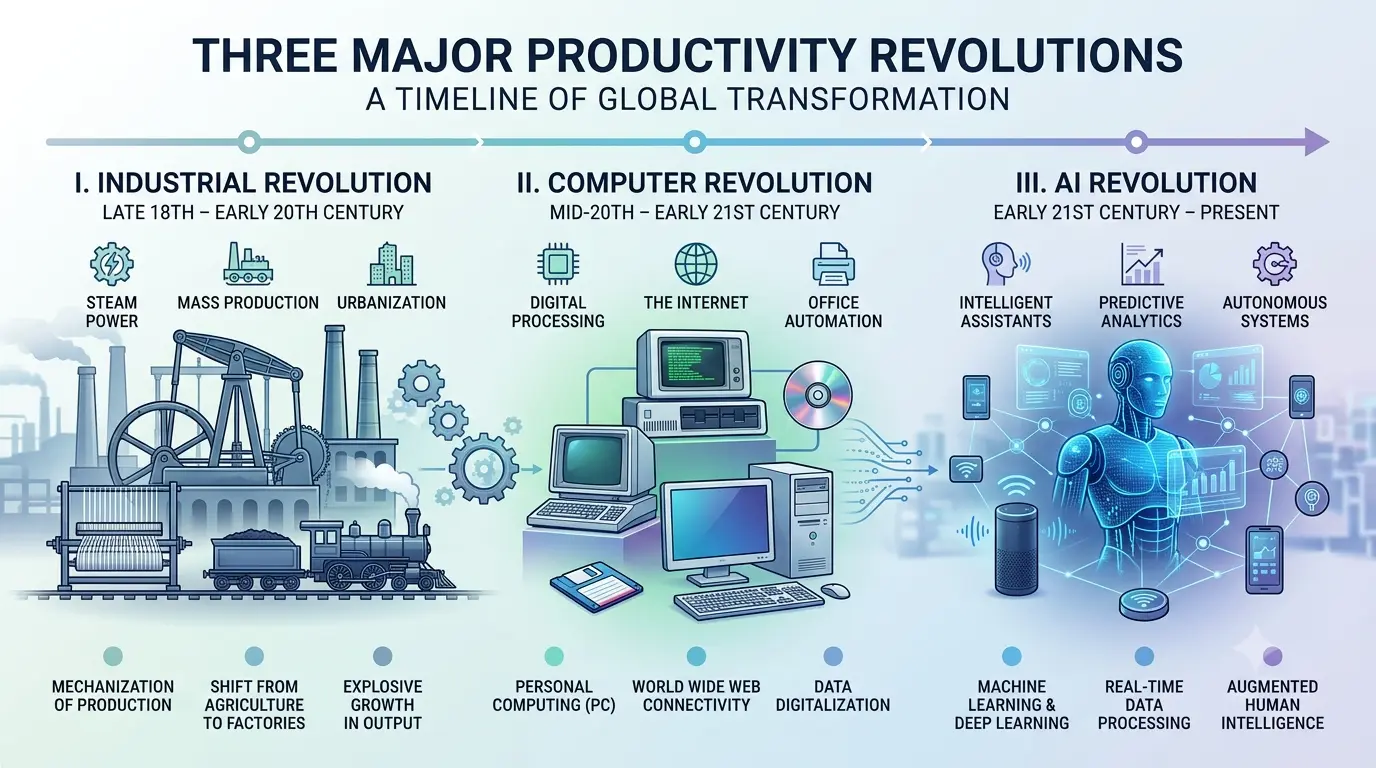
Every major technological revolution has rewarded people who learned how to work with the technology, not just those who owned it.
During the Industrial Revolution, machines increased physical productivity.
Computers increased information productivity.
Today, AI increases cognitive productivity.
The people who learn to collaborate with AI will often complete work faster, explore more ideas, automate repetitive tasks, and spend more time on high-value thinking.
Most professionals don't fail because AI is weak.
They fail because they ask vague questions, accept answers without verification, or expect AI to read their minds.
One of the biggest misconceptions is that AI knows everything.
It doesn't.
Modern AI predicts the most likely next piece of information based on patterns learned during training. It can produce impressive results, but it also has limitations such as inaccurate responses, knowledge boundaries, and reasoning challenges in some situations. These limitations mean human judgment remains essential.
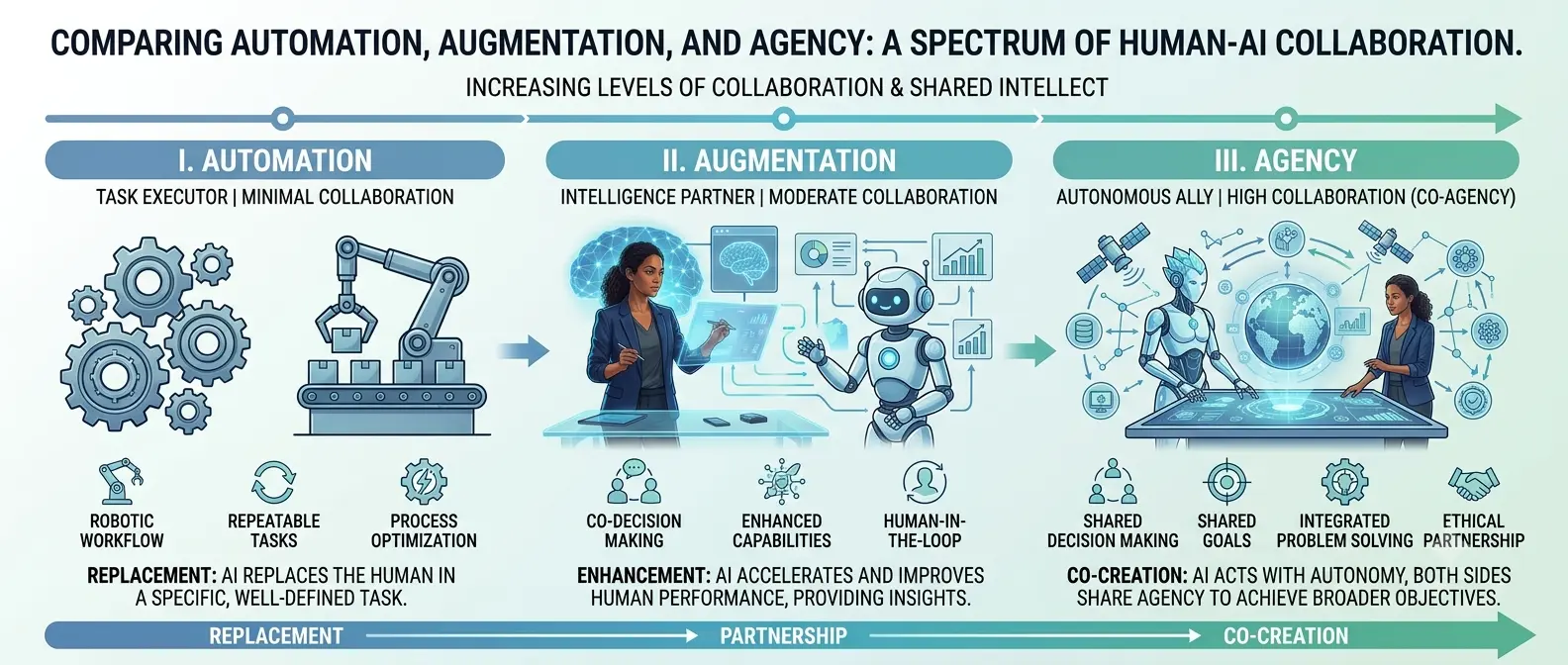
The AI Fluency framework describes three primary collaboration styles.
AI performs a specific task after receiving instructions.
Examples:
Summarizing documents
Writing emails
Translating text
Creating meeting notes
Your role is primarily giving instructions and reviewing the result.
Automation replaces individual tasks.
Augmentation enhances your thinking.
You and AI become teammates.
Instead of asking AI to "do everything," you exchange ideas, refine drafts, challenge assumptions, and iterate together.
This often produces much stronger results than either human or AI working alone.
A data analyst asks AI to brainstorm possible explanations for declining sales.
The AI suggests ten possibilities.
The analyst uses business knowledge to eliminate weak ideas.
Together they discover the actual root cause much faster.
Agency is the most advanced form of collaboration.
Instead of assigning one task at a time, you configure AI with goals, knowledge, and behavioral expectations so it can complete larger workflows with greater independence.
Examples include:
AI customer support agents
AI research assistants
Automated coding assistants
AI workflow systems
Even in these scenarios, humans remain responsible for oversight and final decisions.
A common fear is that AI will replace people.
In reality, the strongest outcomes usually come from combining the complementary strengths of both. The course emphasizes that humans contribute judgment, creativity, critical thinking, and ethical oversight, while AI contributes speed, pattern recognition, and versatility.
Think of AI as a bicycle for the mind.
A bicycle doesn't replace walking.
It helps you travel farther with less effort.
AI works in much the same way for knowledge work.
| Myth | Fact |
|---|---|
| AI knows everything. | AI has limitations and can produce incorrect information. |
| Better AI always means better results. | Better collaboration usually matters more than the model itself. |
| Prompt engineering is about secret tricks. | Clear communication consistently produces better outcomes. |
| AI replaces experts. | AI amplifies experts who know how to evaluate its work. |
AI generates possibilities, not guaranteed truths.
Always verify important information.
Short prompts often produce generic responses.
Context improves quality.
The first response is rarely the final response.
Professionals iterate.
AI assists.
You decide.
You verify.
You remain accountable.
AI Fluency is not about memorizing prompts.
It is about learning a repeatable way to collaborate with AI effectively, efficiently, ethically, and responsibly.
The rest of this guide introduces the framework that makes this possible.
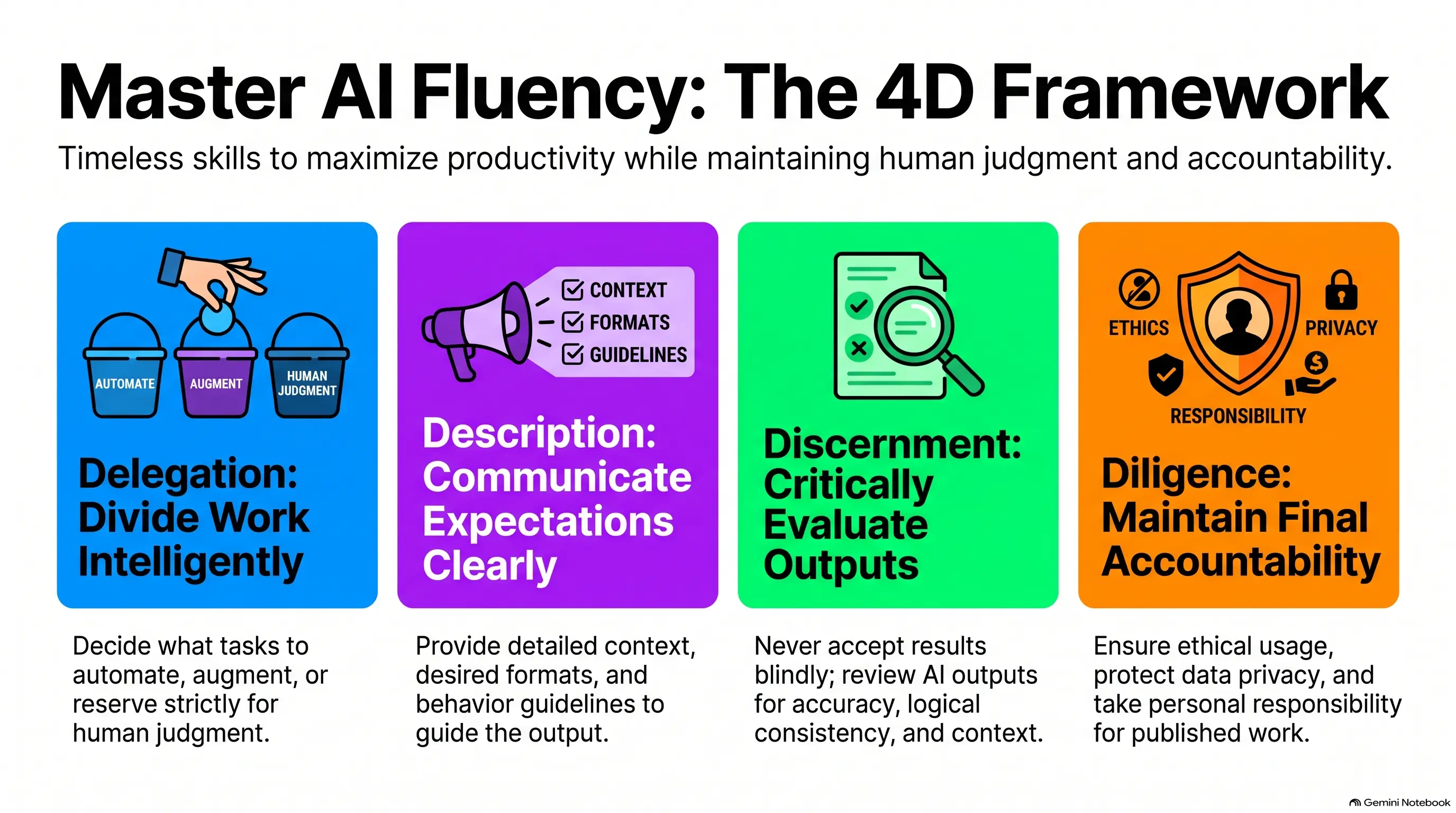
That framework is called The 4Ds.
In the next section, we'll explore Delegation, Description, Discernment, and Diligence—the four core competencies that form the foundation of AI Fluency.
Imagine hiring the smartest intern in the world.
They can write, code, brainstorm, summarize, translate, analyze, and even create images.
But they have one problem.
They don't know what you actually want unless you tell them.
They may confidently produce incorrect information.
They never get tired, but they also don't know when they're wrong unless you check their work.
Would you simply hand them an important project and walk away?
Probably not.
You would:
Decide which tasks they should handle.
Explain what success looks like.
Review their work.
Take responsibility before sharing it.
Interestingly, these four steps are exactly what the AI Fluency Framework teaches.
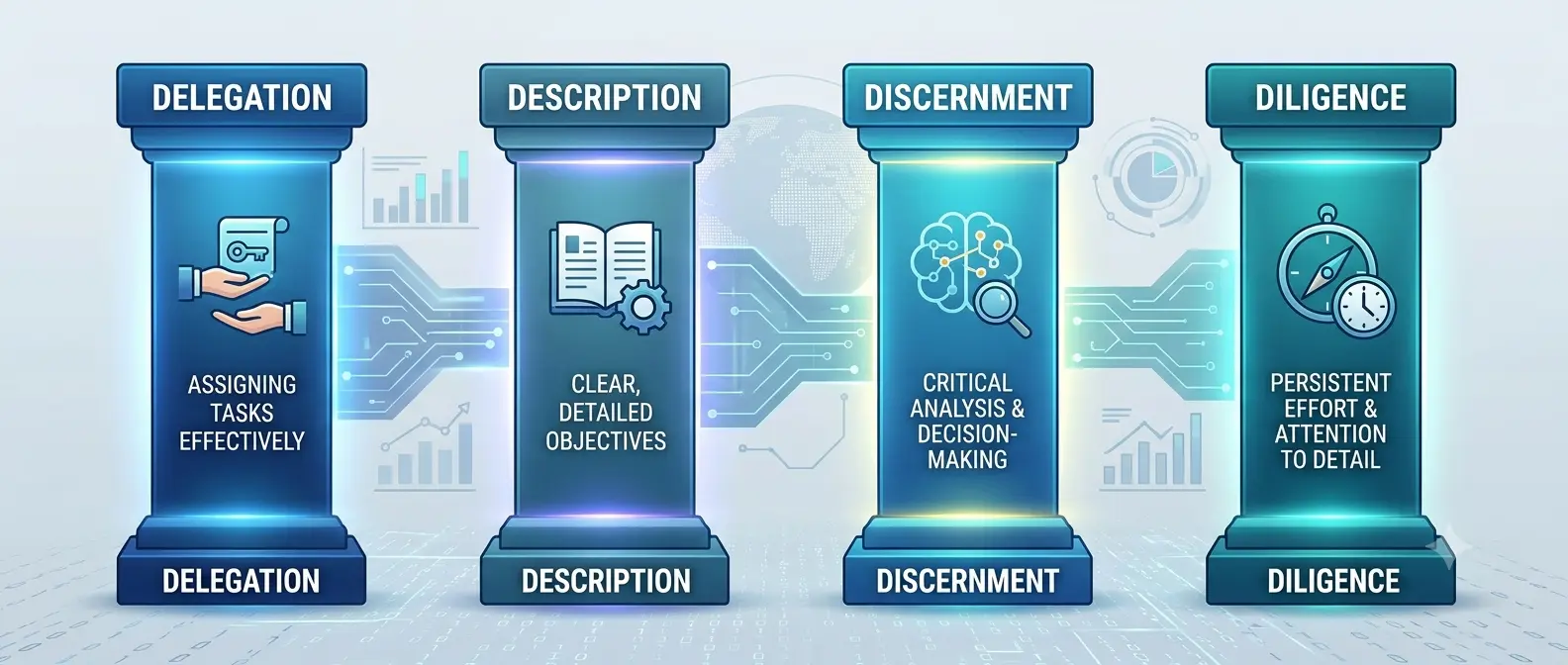
Instead of relying on prompt tricks or memorizing AI hacks, the framework develops four timeless competencies:
Delegation
Description
Discernment
Diligence
These competencies remain valuable even as AI models evolve because they focus on how humans collaborate with AI, not on any specific tool or version.
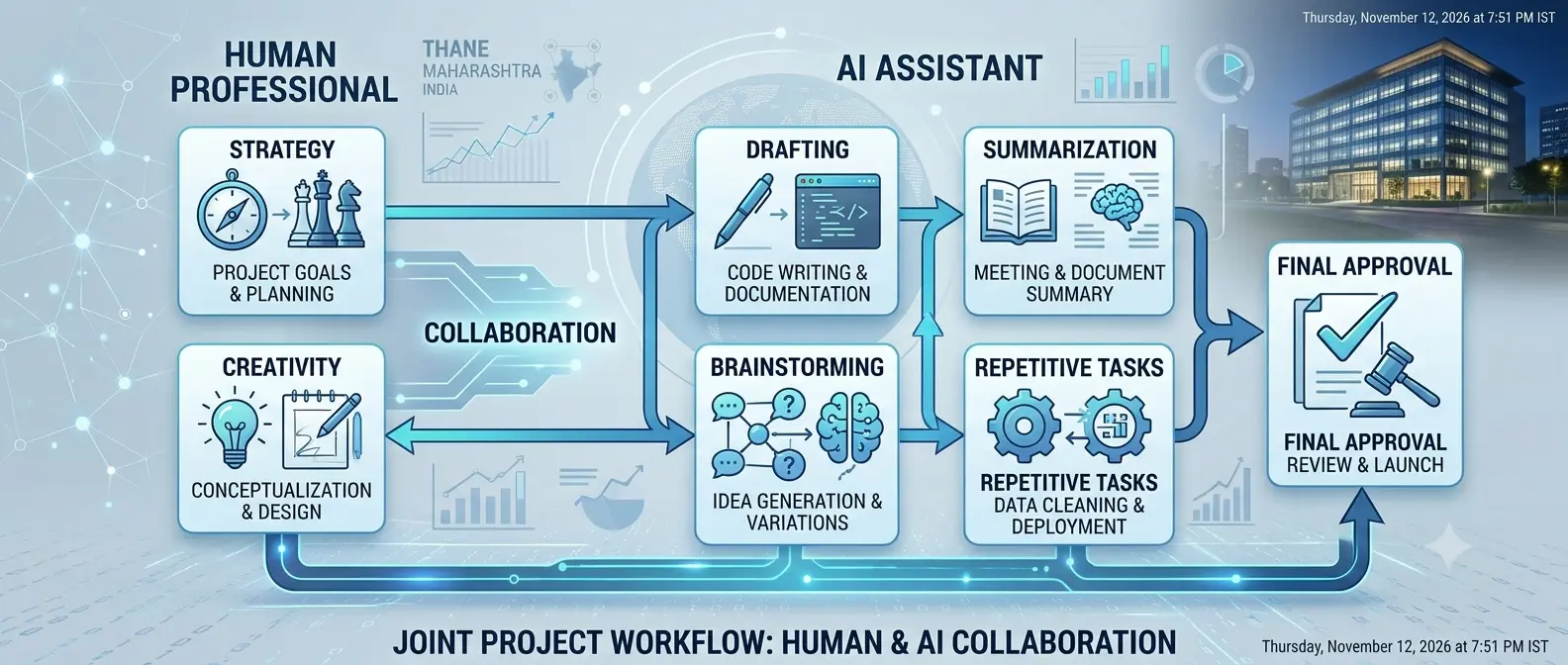
"The smartest people don't do everything themselves. They know what to delegate."
Delegation means deciding:
What should you do?
What should AI do?
What should you do together?
Using AI isn't about replacing yourself.
It's about dividing work intelligently.
According to the AI Fluency framework, Delegation is the ability to make thoughtful decisions about distributing work between humans and AI. It includes understanding your goals, recognizing the capabilities of different AI systems, and assigning tasks where each participant adds the most value.
The framework identifies three components:
Problem Awareness
Platform Awareness
Task Delegation
Before opening ChatGPT, Claude, Gemini, or any AI tool, ask yourself:
"What problem am I actually trying to solve?"
Many people skip this step.
Instead, they immediately start typing prompts.
The result?
AI produces answers to the wrong question.
❌ Bad
"Write me an article."
AI has no idea:
who it's for
how long it should be
why it matters
✅ Better
"Write a beginner-friendly article explaining data visualization for first-year college students. Include simple examples and practical tips."
Now AI understands the goal.
Not every AI system is built for the same purpose.
Some excel at:
Some at:
Others at:
research
image generation
data analysis
design
Professional AI users choose tools based on strengths instead of forcing one tool to solve every problem.
Imagine building a house.
You wouldn't use a hammer for every task.
You'd use:
hammer
drill
measuring tape
saw
level
AI platforms work exactly the same way.
Choosing the right tool often matters more than writing the perfect prompt.
Once you understand your goal and your tools, divide the work.
Example:
Creating a YouTube video.
| Human | AI |
|---|---|
| Choose topic | Brainstorm ideas |
| Verify facts | Draft script |
| Record video | Improve wording |
| Add personality | Generate title ideas |
| Final approval | Suggest thumbnails |
Notice something?
The human remains responsible for the creative vision.
AI accelerates execution.
❌ Asking AI to make every decision.
❌ Trusting AI without checking.
❌ Using AI before understanding the problem.
❌ Assuming automation is always better.
The AI Fluency course emphasizes that the goal is not to automate everything. Instead, it encourages creating the most effective human–AI partnership for each task.
Delegation answers one question:
Who should do what?
Once you've decided that...
You move to the next skill.
Have you ever asked someone to buy "something tasty" from the grocery store?
Maybe they returned with chocolate.
Maybe chips.
Maybe fruit.
Who's wrong?
Nobody.
The instruction was vague.
AI behaves the same way.
Description means explaining your request clearly enough that AI understands exactly what success looks like.
The clearer your communication...
The better your results.
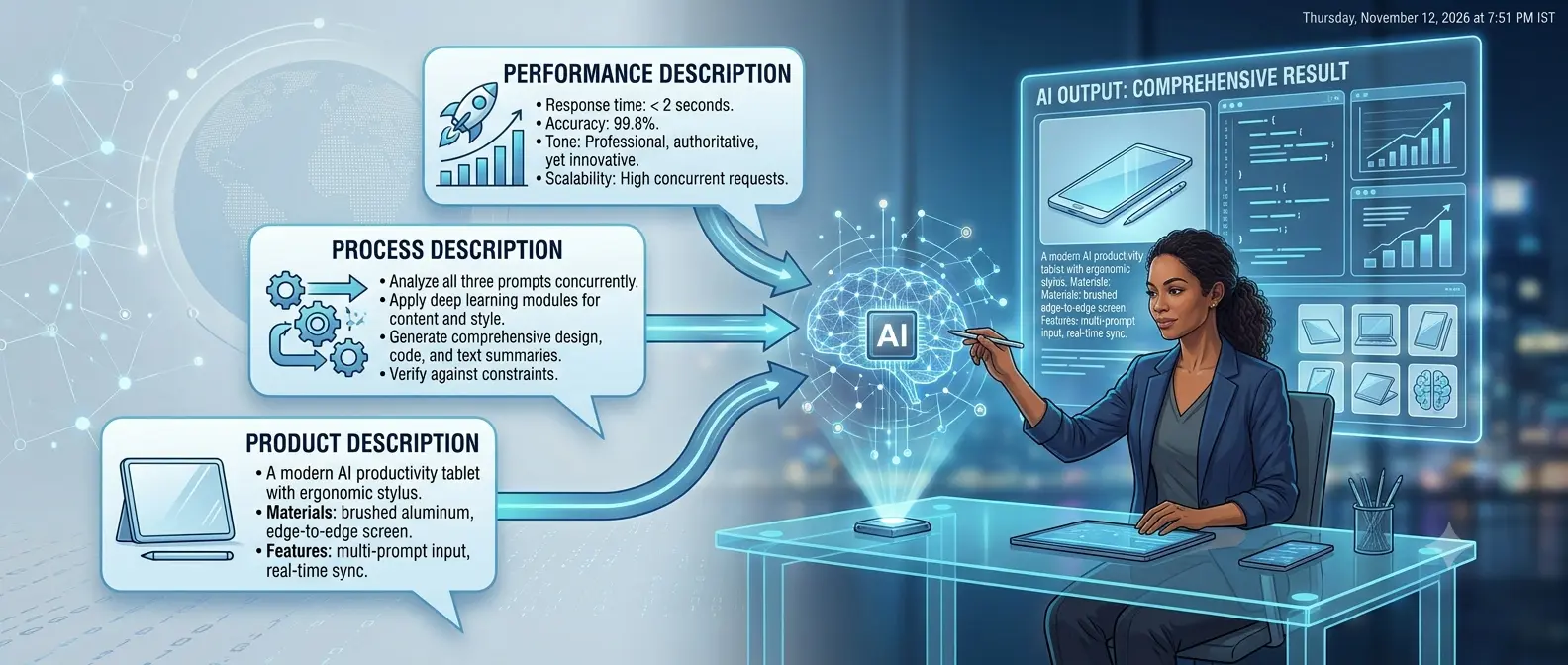
The AI Fluency framework defines Description as creating a productive collaborative environment by clearly communicating:
what you want
how the AI should approach the task
how you want the AI to behave during the interaction
The framework separates Description into three parts:
Product Description
Process Description
Performance Description
This answers:
What should AI create?
Examples include:
blog article
Python script
SQL query
marketing campaign
Power BI dashboard
presentation
The more specific the outcome...
The better the output.
This answers:
How should AI solve the problem?
For example:
"Think step by step."
"Compare three approaches."
"Use first principles."
"Explain like I'm 15."
You're not just describing the destination.
You're describing the journey.
This answers:
How should AI behave?
Examples:
challenge my ideas
act as a mentor
be concise
explain every concept
ask questions before answering
provide citations
think critically
These instructions shape the collaboration itself rather than only the final output.
Imagine asking an architect:
"Design me a house."
You'll probably get dozens of different designs.
Now imagine saying:
Design a two-story modern family home with four bedrooms, large windows, solar panels, a home office, and a budget of $250,000.
Same architect.
Much better result.
AI works exactly the same way.
Many people believe prompting is about secret words.
It isn't.
Good prompts are simply good communication.
The course reinforces this by recommending practical techniques such as providing context, showing examples, specifying constraints, breaking complex tasks into steps, defining the AI's role, and iteratively refining prompts.
Description answers one question:
How do I communicate clearly enough for AI to help me effectively?
Once AI produces an answer...
Your next skill begins.
Discernment.
Imagine you ask three experienced chefs to make the same pasta dish.
Each chef follows a different recipe.
Each meal looks slightly different.
Which one is correct?
Maybe all of them.
Maybe none of them.
You can't answer unless you know what "good" looks like.
Working with AI is no different.
Receiving an answer is only half the job.
The other half is deciding whether that answer deserves your trust.
Discernment is your ability to evaluate AI's work.
Instead of asking,
"Did AI answer?"
you ask,
"Did AI answer correctly?"
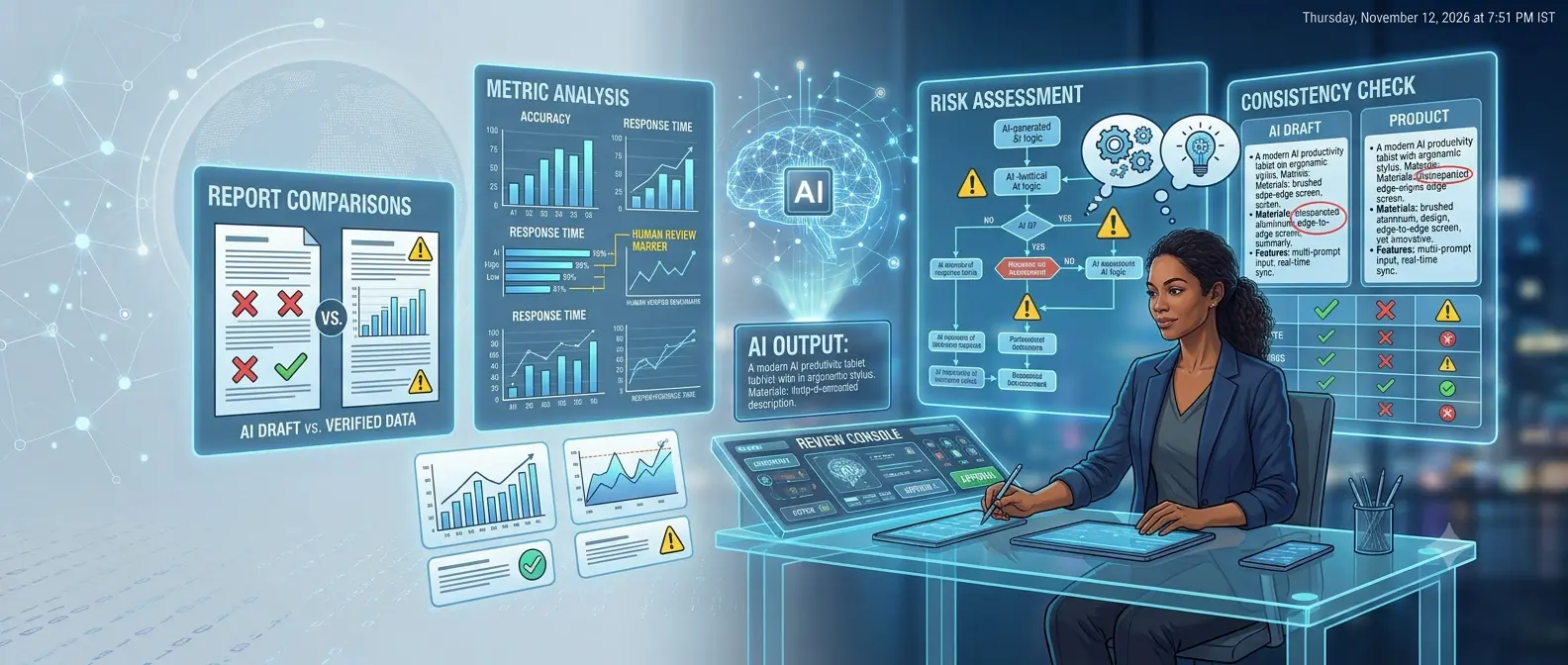
The AI Fluency framework defines Discernment as the ability to thoughtfully evaluate AI outputs, reasoning processes, and collaborative behavior. It emphasizes that human judgment remains essential throughout AI-assisted work.
Discernment consists of three complementary skills:
Product Discernment
Process Discernment
Performance Discernment
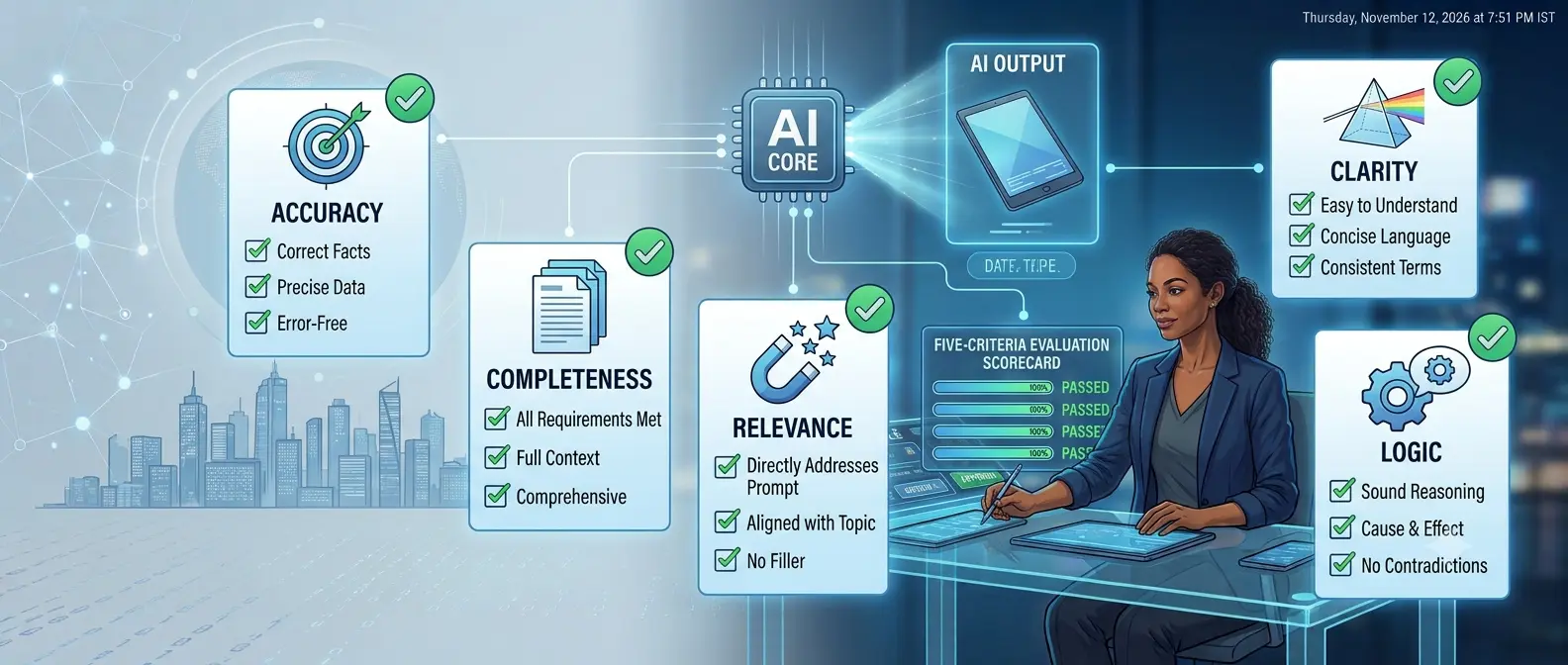
The first question is simple:
Is the output actually good?
Look for:
Accuracy
Completeness
Relevance
Clarity
Logical consistency
Suppose AI generates SQL code.
Don't immediately copy it.
Instead ask:
Does it return the correct data?
Are there performance issues?
Are joins correct?
Does it follow company standards?
Professionals review.
Beginners trust.
That single habit often separates experienced AI users from everyone else.
Sometimes the answer looks correct.
But the reasoning behind it is flawed.
Process Discernment asks:
How did AI arrive at this answer?
Look for:
Missing assumptions
Weak logic
Skipped reasoning
Unsupported conclusions
False comparisons
Imagine AI recommends increasing advertising because sales decreased.
That sounds reasonable.
But what if:
inventory was unavailable?
prices increased?
competitors launched new products?
Without examining the reasoning process, the recommendation may be misleading.
Performance Discernment evaluates the collaboration itself.
Ask questions such as:
Did AI understand my instructions?
Did it adapt after feedback?
Was the explanation appropriate for my audience?
Was it concise when needed?
Did it ask clarifying questions?
According to the framework, evaluating the AI's behavior during collaboration is just as important as evaluating its output.
Imagine you're building a Power BI dashboard.
AI suggests:
Remove several charts to simplify the report.
Should you?
Maybe.
Maybe not.
A skilled analyst asks:
Which stakeholders use this dashboard?
Which visuals support business decisions?
Is the recommendation based on UX principles or just reducing clutter?
Discernment means using your own expertise before accepting AI's suggestions.
One challenge with AI is that incorrect answers can sound convincing.
AI often writes with confidence.
Confidence is not evidence.
Always verify important information, especially in areas such as healthcare, finance, engineering, legal advice, or safety-critical work.
| Myth | Fact |
|---|---|
| AI sounds confident, so it must be correct. | Confidence does not guarantee accuracy. |
| AI replaces expertise. | Expertise improves AI results because experts can evaluate outputs effectively. |
| The first answer is usually the best answer. | High-quality AI work is iterative. |
The AI Fluency course recommends evaluating not only what AI produced, but also how it produced it and how it collaborated with you.
Discernment answers one important question:
Can I trust this output?
If the answer is "not yet"...
Improve the conversation.
Don't simply abandon it.
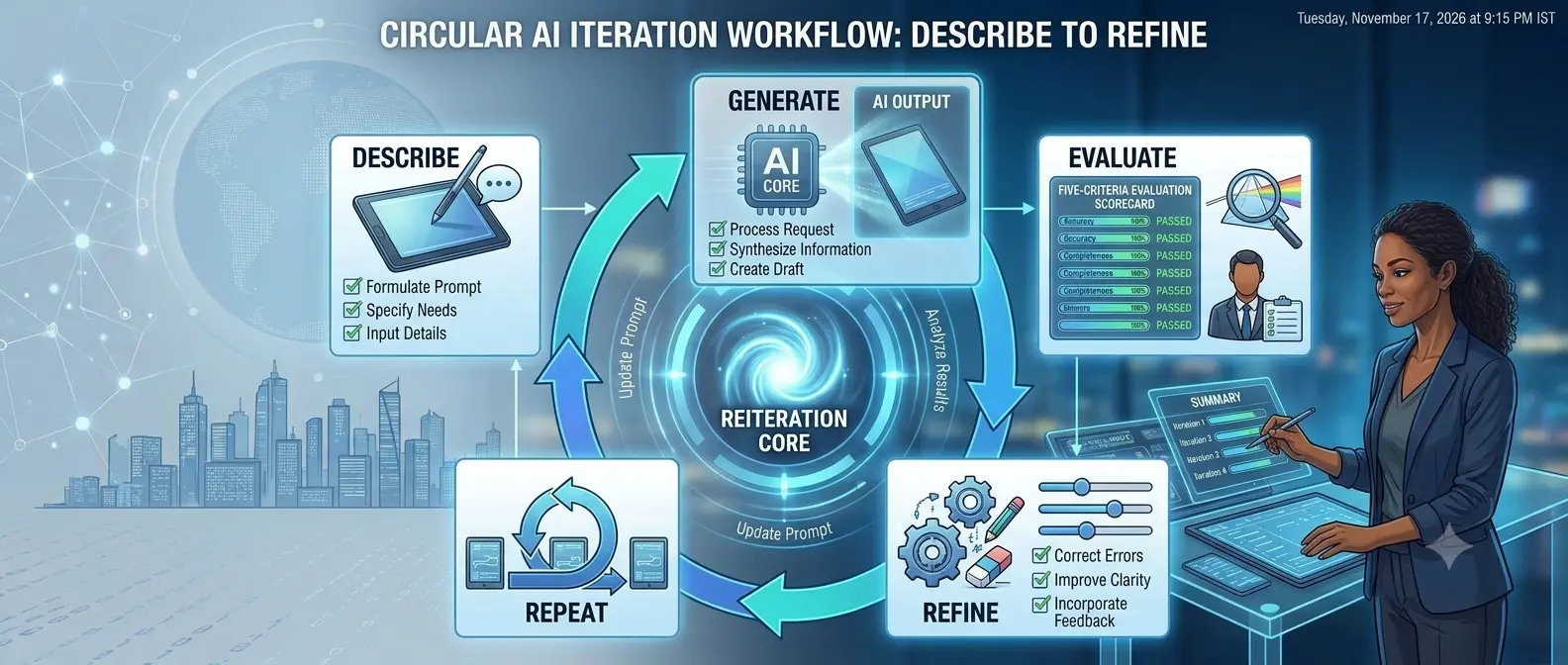
One of the most powerful ideas in AI Fluency is that Description and Discernment are not separate activities.
They form a continuous feedback loop.
Think of it like steering a car.
You don't set the steering wheel once.
You constantly make small adjustments.
Working with AI follows the same pattern.
Describe what you want.
Review the result.
Identify what can improve.
Refine your instructions.
Repeat.
This cycle continues until the output meets your standards. The course describes this iterative process as using Description and Discernment together throughout project execution.
Imagine publishing an article written entirely by AI.
Later, readers discover several factual mistakes.
Who is responsible?
The AI?
No.
You are.
That is why Diligence matters.
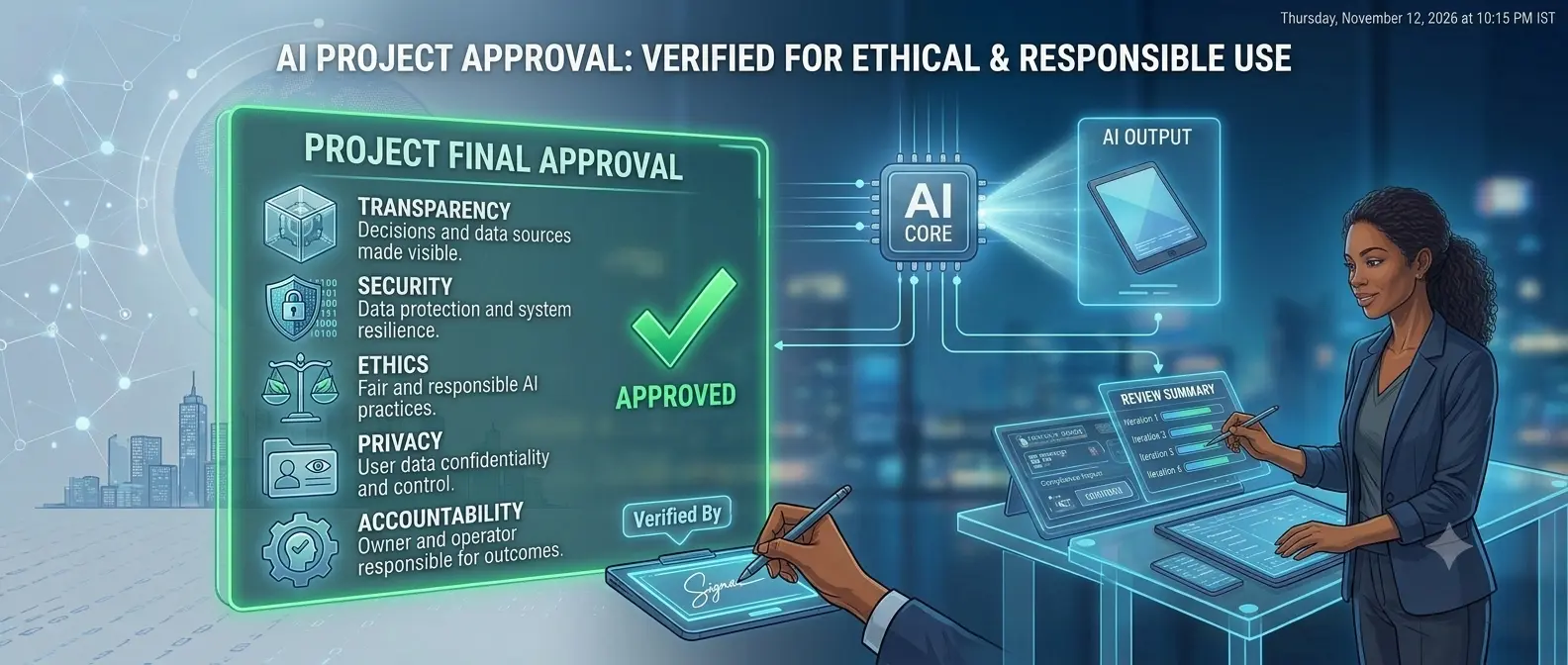
Diligence means using AI responsibly.
You remain accountable for the final work.
Within the AI Fluency framework, Diligence focuses on responsible and ethical collaboration with AI. It includes thoughtful tool selection, transparency about AI's role, and taking responsibility for AI-assisted outputs before sharing them.
The framework divides Diligence into:
Creation Diligence
Transparency Diligence
Deployment Diligence
Ask yourself:
Which AI system is appropriate?
What information should I share?
Are there privacy concerns?
Am I exposing confidential data?
Responsible AI begins before the first prompt.
Sometimes people deserve to know AI helped create your work.
Examples include:
academic assignments
research reports
company documentation
public publications
Different organizations have different expectations.
Be honest about AI's role whenever appropriate.
Before publishing anything, ask:
Have I verified the facts?
Have I tested the code?
Have I reviewed the analysis?
Would I confidently put my name on this?
If not...
Don't publish it.
The course encourages creating a statement acknowledging AI's contribution while affirming your responsibility for the final work. Such a statement identifies the AI system used, describes how it assisted, explains the review process, and makes clear that the human creator accepts responsibility for the finished output.
One of the biggest misunderstandings about AI is believing it should make final decisions.
AI is excellent at:
generating ideas
summarizing information
drafting content
brainstorming
organizing knowledge
Humans remain responsible for:
ethics
judgment
context
accountability
final approval
That's what AI Fluency teaches.
Imagine creating a blog post.
Chooses the topic.
Defines the audience.
Verifies facts.
Adds personal experience.
Publishes.
Generates outlines.
Improves grammar.
Suggests headlines.
Creates examples.
Refines structure.
The best work comes from combining these strengths—not replacing one with the other.
❌ Treating AI as an oracle.
❌ Sharing confidential company information without considering privacy.
❌ Publishing AI-generated content without review.
❌ Ignoring organizational policies about AI usage.
❌ Assuming one AI tool is best for every task.
✔ Decide which work belongs to humans and which belongs to AI.
✔ Describe your requests clearly.
✔ Evaluate every important output critically.
✔ Refine through continuous feedback.
✔ Use AI responsibly.
✔ Stay accountable for everything you publish.
Now that you've mastered the four competencies of AI Fluency, it's time to put them into practice.
In the final section, we'll learn:
Advanced prompting strategies
Complete AI workflows
End-to-end project planning
Common misconceptions
Frequently Asked Questions
AI Fluency cheat sheet
Final conclusion
Production-ready publishing notes
Learning AI Fluency is like learning to ride a bicycle.
You can read every book about cycling.
You can watch hundreds of videos.
But until you actually ride...
You aren't fluent.
AI works exactly the same way.
Fluency develops through repeated practice.
Each project teaches you something new.
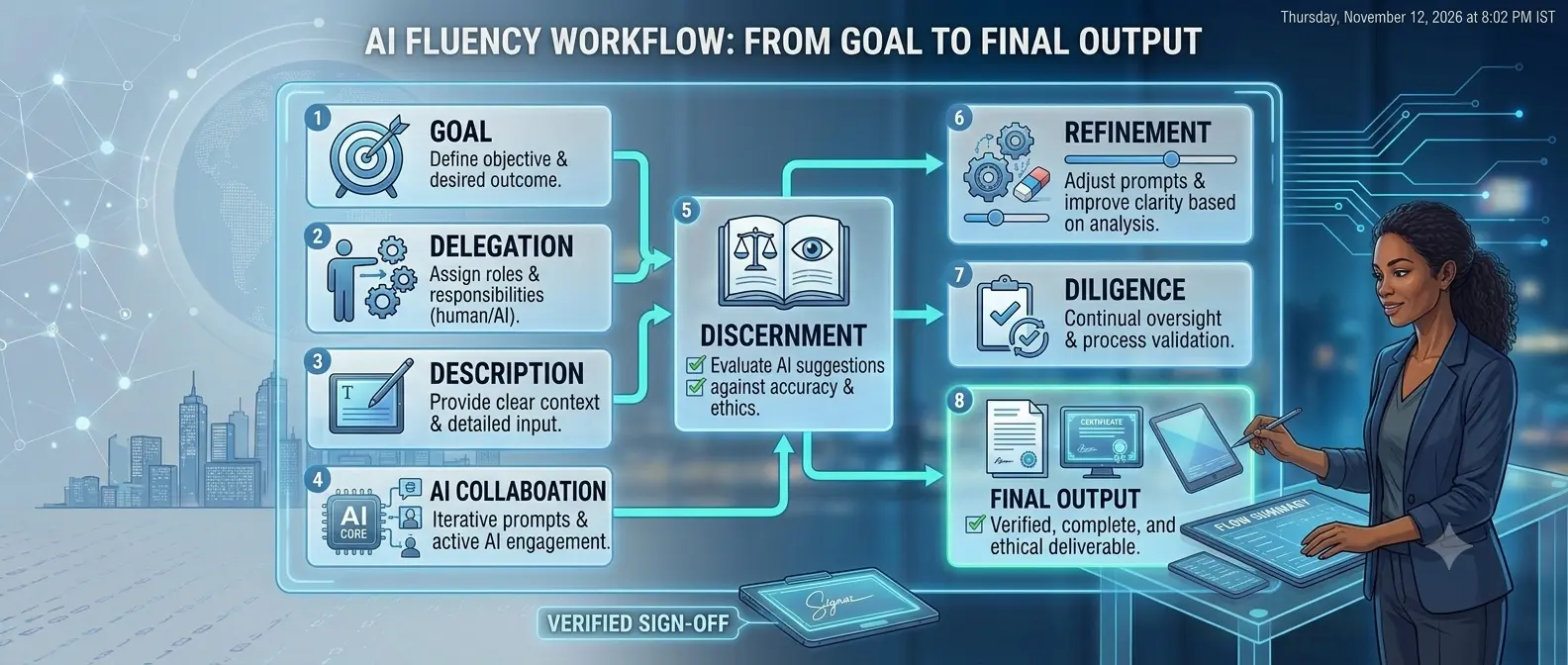
Here's a simple workflow you can use for almost any AI-assisted project.
Ask yourself:
What am I trying to accomplish?
What should I do myself?
What can AI help with?
Don't open an AI tool until you're clear about the destination.
Provide:
context
audience
desired outcome
format
constraints
examples if possible
Remember:
AI cannot read your mind.
It can only understand what you communicate.
Review every important output.
Check:
facts
logic
tone
completeness
relevance
Ask AI to explain its reasoning if something seems unclear.
Rarely is the first response the final one.
Professionals iterate.
Examples:
"Explain this more simply."
"Use real business examples."
"Rewrite for beginners."
"Compare three approaches."
Small adjustments often produce dramatically better results.
Before publishing:
✔ Check facts
✔ Test code
✔ Review calculations
✔ Remove confidential information
✔ Confirm citations
✔ Accept responsibility for the final version
Imagine you're creating a hospital dashboard in Power BI.
Define business goals yourself.
Let AI suggest KPIs.
Use AI to draft DAX formulas.
Choose the final metrics.
Instead of saying:
Create a dashboard.
Say:
Design a Power BI dashboard for hospital executives that tracks admissions, readmissions, emergency visits, patient satisfaction, and average length of stay. Use a clean executive layout with accessible colors.
Review:
Are the KPIs meaningful?
Are calculations correct?
Are visuals appropriate?
Is anything misleading?
Before presenting:
Validate the data.
Confirm calculations.
Review with stakeholders.
Ensure patient privacy is protected.
Notice how all four competencies work together.
The course presents several practical prompting techniques that consistently improve AI interactions. These include:
Giving sufficient context
Showing examples of the desired output
Specifying constraints such as length or format
Breaking complex work into smaller steps
Defining the AI's role or tone
Iterating and refining based on results
Rather than memorizing "magic prompts," focus on communicating clearly and refining your requests over time.
Search engines retrieve information.
AI collaborates.
The interaction is conversational.
AI is a powerful assistant.
It is not an infallible expert.
The best AI users don't disappear from the process.
They contribute judgment, experience, and creativity.
The first answer starts the conversation.
The best answers often emerge after several rounds of refinement.
Different AI systems have different strengths.
Choose tools based on the task, not habit.
| Competency | Key Question |
|---|---|
| Delegation | Who should do what? |
| Description | How do I communicate clearly? |
| Discernment | Can I trust this result? |
| Diligence | Am I using AI responsibly? |
If you remember only these four questions, you're already thinking like an AI-fluent professional.
No.
Anyone who works with information can benefit, including students, teachers, marketers, analysts, designers, writers, entrepreneurs, researchers, and business leaders.
No.
Prompt engineering is one useful skill, but AI Fluency is broader. It includes deciding when to use AI, communicating effectively, evaluating outputs, and taking responsibility for the results.
AI is changing how many jobs are performed, but the course emphasizes human–AI collaboration rather than complete replacement. Human judgment, creativity, and responsibility remain central to effective AI use.
Practice consistently.
Use AI on real projects.
Review your results critically.
Learn from each interaction.
Over time, your collaboration skills will improve naturally.
AI Fluency is about collaboration, not simply using AI tools.
Strong AI users decide what to delegate rather than automating everything.
Clear communication produces better AI outputs.
Human judgment is essential for evaluating AI-generated work.
Responsibility always stays with the human creator.
AI Fluency is a skill developed through continuous practice.
Artificial intelligence is transforming the way we learn, create, solve problems, and make decisions.
But technology alone isn't enough.
Owning the latest AI model won't automatically make you more productive—just as owning a piano doesn't make you a musician.
The real advantage belongs to people who know how to collaborate effectively.
That's the purpose of AI Fluency.
By practicing the four competencies—Delegation, Description, Discernment, and Diligence—you build a repeatable framework that applies across tools, industries, and future AI systems. The course concludes by emphasizing that these competencies remain valuable because AI Fluency is developed through intentional practice, not by mastering a single model or prompt.
As AI continues to evolve, new tools will appear.
Interfaces will change.
Capabilities will improve.
The principles of thoughtful human–AI collaboration, however, will remain timeless.
Master those principles, and you'll be prepared not just for today's AI—but for tomorrow's as well.
