Imagine spending six months learning SQL, Python, Excel, and Power BI.
You build projects.
You earn certifications.
Then one day you open YouTube and see dozens of videos saying:
"AI has replaced Data Analysts."
Another creator says:
"Nobody is hiring freshers anymore."
Then another claims:
"Learn Prompt Engineering instead."
If you're confused, you're not alone.
Thousands of students, career switchers, and even experienced professionals are asking the same question:
Is Data Analytics still worth learning in 2026?
The short answer is:
Yes—but not in the same way it was five years ago.
The role hasn't disappeared.
It has evolved.
The people who learn modern analytics with AI will have opportunities.
The people who learn outdated skills hoping to get a job simply because they know Excel may struggle.
This article explains what actually changed, what employers want in 2026, and whether Data Analytics is still one of the smartest careers you can choose.
If you only remember one thing from this article, remember this:
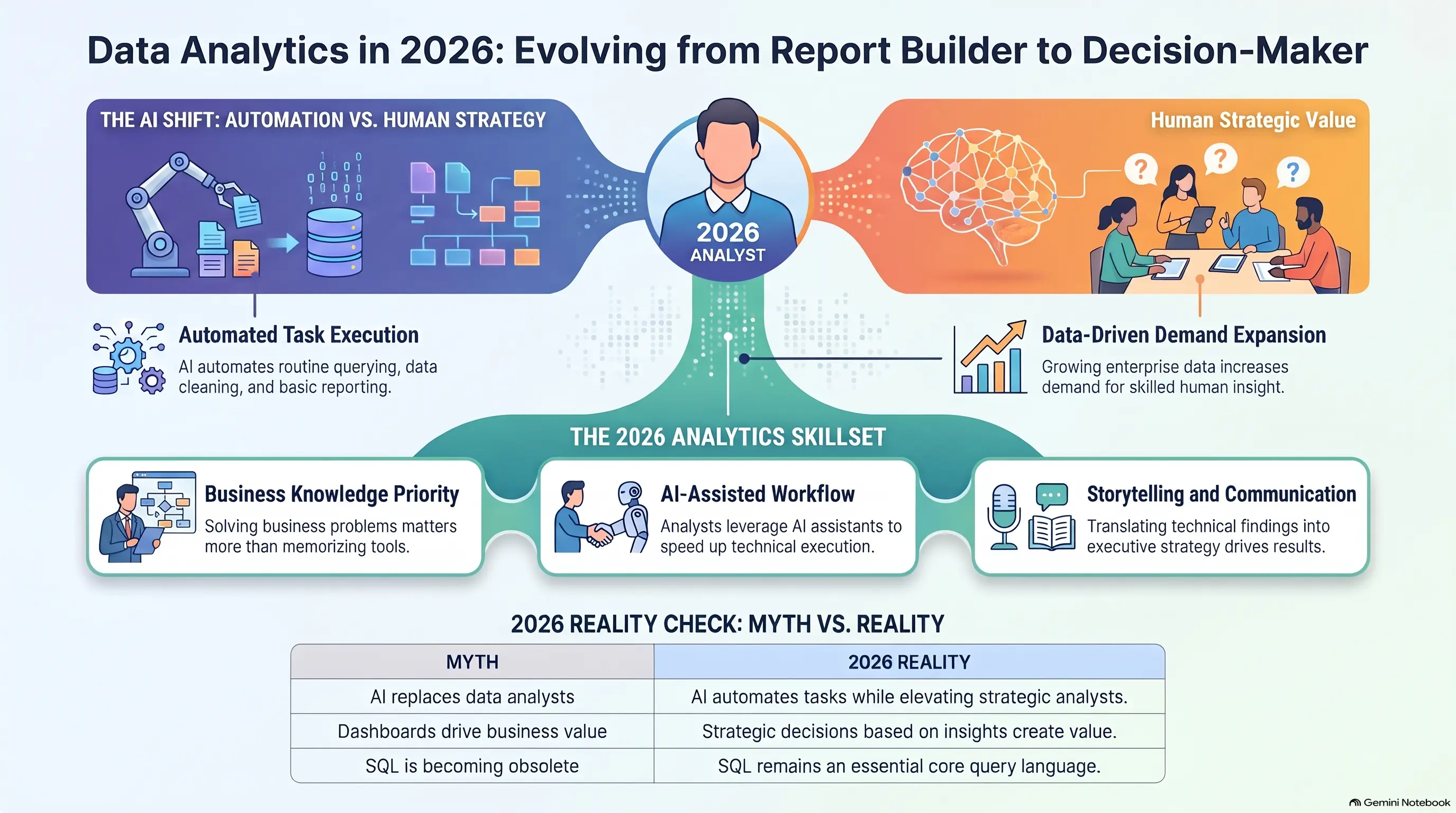
Data Analytics is not dying. Basic data work is becoming automated, while skilled analysts who can combine business knowledge, SQL, visualization, statistics, and AI are becoming more valuable.
This guide is for:
No prior knowledge is required.
We'll explain every concept from beginner level before moving to advanced ideas.

Five years ago, the answer was simple.
Companies were collecting more data than ever before.
Every business needed analysts.
Learning SQL and Power BI almost guaranteed interview opportunities.
Then everything changed.
Artificial Intelligence entered the workplace.
Tools like ChatGPT, Microsoft Copilot, Claude, Gemini, and countless AI-powered Business Intelligence platforms started writing SQL queries, generating charts, explaining dashboards, and even summarizing reports.
Naturally, people started asking:
"If AI can analyze data, why would companies hire analysts?"
It's a reasonable question.
But it's also based on a misunderstanding of what professional data analysts actually do.
A Data Analyst helps businesses make better decisions using data.
That's it.
Everything else is just a way to achieve that goal.
A Data Analyst collects, cleans, transforms, analyzes, visualizes, and communicates data to answer business questions and support strategic decision-making.
Their job isn't simply creating dashboards.
Their job is helping organizations make better decisions.
Imagine a hospital notices that patient waiting times increased from 20 minutes to 65 minutes.
The hospital director doesn't need another dashboard.
They need answers.
A Data Analyst investigates:
The dashboard is only one part of solving the problem.
The real value comes from understanding why something happened and recommending what to do next.
Many executives don't ask for "more data."
They ask for better decisions.
That's why companies pay analysts.

Imagine someone gives you a treasure map.
You don't become rich simply because you own the map.
You still have to:
Business data works exactly the same way.
Companies already have enormous amounts of data.
Their biggest challenge isn't collecting more.
It's understanding what the data means.
That is where skilled analysts create value.
This is the question everyone really wants answered.
The honest answer is:
AI is replacing tasks—not the entire profession.
That distinction matters.
When calculators became popular, people predicted accountants would disappear.
Instead:
The same thing is happening with AI.
These are valuable capabilities.
But notice something.
They're mostly repetitive tasks.
These are human skills.
And they're becoming even more valuable.
| Myth | Fact |
|---|---|
| AI replaced Data Analysts | AI automates many analyst tasks but increases demand for analysts who can use AI effectively. |
| Dashboards are enough | Businesses pay for insights, not dashboards. |
| SQL is becoming useless | SQL remains one of the most requested analytics skills. |
| Excel is dead | Excel is still heavily used across industries. |
| Beginners have no chance | Competition has increased, but practical skills and portfolios matter more than ever. |
The biggest change isn't AI.
The biggest change is expectations.
A few years ago, employers often hired analysts who could create reports.
Today, many employers expect analysts to:
In other words,
The job became more valuable.
But also more demanding.
Modern analysts don't compete against AI.
They work with it.
Instead of spending four hours cleaning spreadsheets, they let AI perform much of the repetitive work.
That gives them more time to:
This is why many companies are no longer looking for people who simply "know Power BI."
They're looking for people who know how to solve business problems using data and AI together.
Here's what we've learned so far:

This is probably the most important question after "Is it worth learning?"
Let's answer it with logic before opinions.
Imagine opening a hospital.
Would you rather make decisions based on:
Now replace "hospital" with:
The answer doesn't change.
As businesses collect more data every day, they need people who can turn that data into decisions.
That fundamental need hasn't disappeared.
In fact, it has become even more important.
Every action you take online creates data.
Watching YouTube.
Ordering food.
Using Google Maps.
Shopping online.
Paying through UPI.
Visiting a hospital.
Even walking with your smartwatch.
Businesses don't just collect this data for fun.
They collect it because it helps them improve products, reduce costs, detect fraud, personalize experiences, and make better decisions.
Organizations are experiencing exponential data growth from transactional systems, IoT devices, cloud platforms, mobile applications, CRM systems, ERP software, social media, and AI applications.
More data means more opportunities—but only if someone can analyze it correctly.
Think about Netflix.
Millions of people watch movies every day.
Netflix doesn't simply count views.
It analyzes:
Every one of those decisions depends on data analytics.
Here's something many beginners misunderstand.
Companies don't hire analysts because dashboards are difficult to build.
They hire analysts because business problems are difficult to solve.
Imagine your manager asks:
"Our sales dropped by 18% last quarter. Why?"
There isn't a single button in ChatGPT that magically knows:
Someone has to investigate.
Someone has to ask better questions.
Someone has to validate the data.
Someone has to communicate the findings.
That "someone" is usually the analyst.
Think of Iron Man.
Tony Stark is brilliant.
His AI assistant, JARVIS, is incredibly powerful.
But JARVIS doesn't decide what problem to solve.
Tony does.
Modern AI tools work the same way.
They can:
But they still depend on human direction.
The better the analyst, the better the AI becomes.
Did You Know?
The quality of AI-generated analysis depends heavily on the quality of the question you ask.
Experienced analysts usually ask better questions than beginners.

One of the biggest myths is that only technology companies hire analysts.
The reality is very different.
Almost every industry now relies on data.
Here are some of the biggest employers.
Healthcare organizations analyze data to:
A hospital notices emergency room waiting times are increasing.
A Data Analyst identifies that staffing is insufficient between 6 PM and 10 PM.
The hospital adjusts schedules.
Waiting time drops.
No new building was required.
Only better decisions.
Banks analyze data for:
Every credit card swipe creates valuable data.
Companies like Amazon and Flipkart analyze:
Without analytics, modern e-commerce wouldn't function efficiently.
Manufacturers analyze data to:
This is often called Predictive Maintenance.
Instead of fixing machines after they break, companies predict failures before they happen.
Retail businesses study:
Analytics helps stores stock the right products at the right time.
Modern sports teams use analytics for:
Moneyball, one of the most famous sports stories, showed how data could outperform traditional scouting.
Governments analyze data for:
Data Analytics isn't only a private-sector skill.
It's becoming a public-sector necessity as well.
Many beginners ask,
"What should I learn?"
The better question is:
"What problems should I learn to solve?"
Tools change.
Problem-solving doesn't.
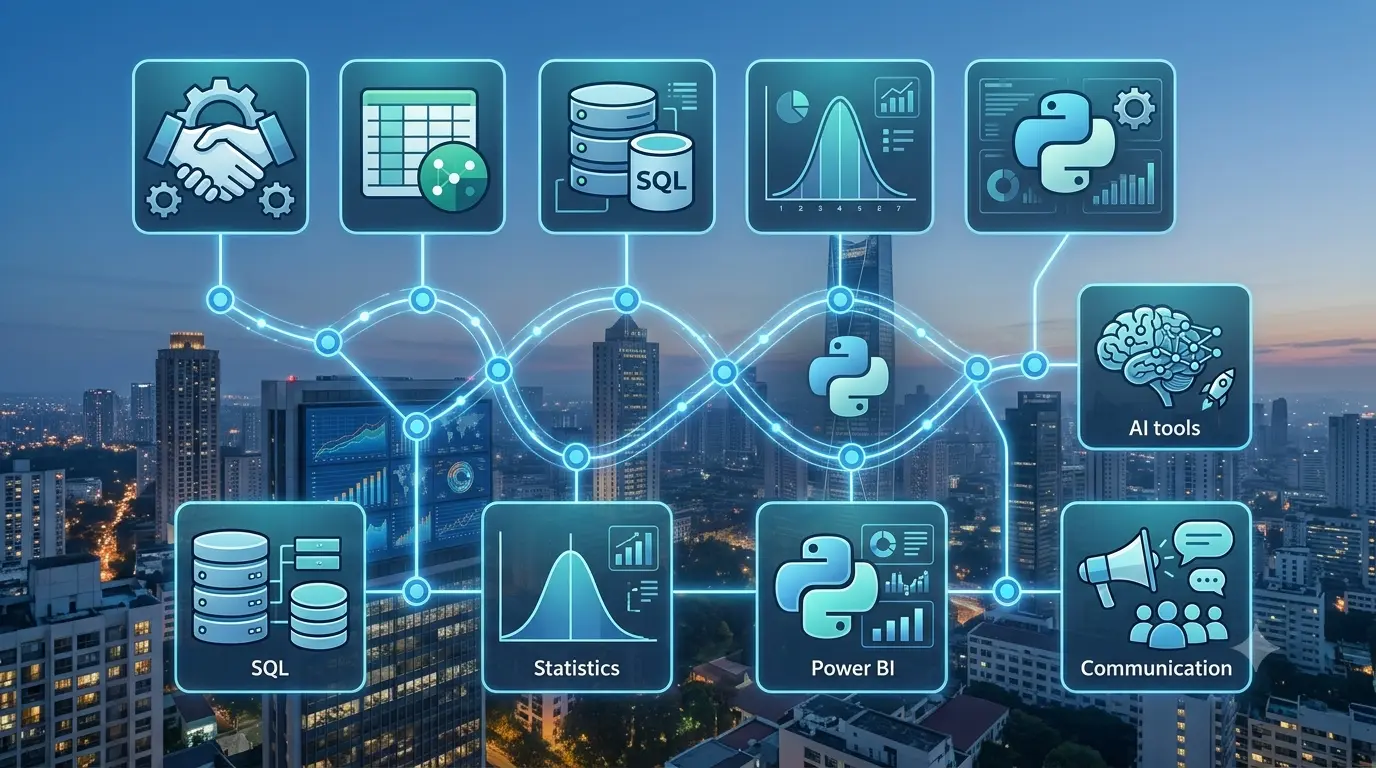
Still, employers expect a practical toolkit.
Excel is still one of the fastest ways to analyze small and medium-sized datasets.
Excel remains widely used for reporting, pivot tables, financial modeling, ad hoc analysis, and business operations.
A sales manager receives yesterday's sales report.
Opening Excel is usually faster than importing the data into Python.
SQL helps you retrieve data from databases.
Structured Query Language (SQL) is the standard language for querying relational databases.
It is one of the most important skills for analysts.
Instead of searching millions of customer records manually,
SQL retrieves exactly what you need in seconds.
Visualization tools help people understand data.
Executives don't want spreadsheets.
They want answers.
Dashboards help communicate those answers clearly.
You don't need a PhD.
But you do need to understand:
Without statistics,
it's easy to reach incorrect conclusions.
This is the skill beginners underestimate the most.
Knowing SQL doesn't automatically tell you why profits dropped.
Understanding the business does.
Always ask:
Modern analysts use AI every day.
Examples include:
AI should increase your productivity—not replace your thinking.
Think of your skills like building a house.
| Layer | Purpose |
|---|---|
| Business Knowledge | Understand the problem |
| Statistics | Make reliable conclusions |
| SQL | Retrieve data |
| Excel | Quick analysis |
| Python | Automation and advanced analysis |
| Power BI / Tableau | Visualization |
| AI | Speed up repetitive work |
| Communication | Influence decisions |
Notice something interesting.
Programming isn't at the top.
Communication is.
Because insights only create value when people understand and act on them.
Learning tools without solving problems.
Collecting certificates instead of projects.
Watching tutorials without practicing.
Ignoring business knowledge.
Trying to learn everything at once.
Instead of learning like this:
Excel → SQL → Python → Statistics → Power BI → AI
Learn like this:
Business Problem
↓
Data
↓
Excel
↓
SQL
↓
Visualization
↓
Insights
↓
Business Decision
↓
Automation with AI
Every tool should help solve a real problem.
Imagine you own a coffee shop.
Sales suddenly drop.
A beginner asks:
"How do I build a dashboard?"
A good analyst asks:
Notice the difference?
The dashboard comes later.
The questions come first.
Here's what we've learned in this section:

By now, we've established two important facts:
But another question remains.
Is it too late to start?
If you're a beginner, it might feel like everyone else already knows SQL, Python, Power BI, machine learning, cloud computing, and AI.
The truth is much simpler.
Every year, millions of students graduate.
Thousands switch careers.
Companies launch new products.
Businesses adopt new technologies.
That means new data—and new problems to solve.
There will always be demand for people who can turn data into better decisions.
The challenge isn't finding opportunities.
The challenge is becoming the kind of analyst companies actually want to hire.
No—but the market for average candidates is.
Entry-level competition has increased because learning resources are widely available. However, organizations continue to seek candidates who demonstrate practical problem-solving, business understanding, communication skills, and project experience.
Imagine two candidates.
Candidate A
Candidate B
Who gets the interview?
Almost always, Candidate B.
Companies hire people who can solve problems—not people who collect certificates.
Yes—but not in the way many people think.
Certifications help prove that you've learned a topic.
They do not prove you can solve real business problems.
Think of a driving license.
It proves you're allowed to drive.
It doesn't prove you're a Formula 1 driver.
The same applies to certifications.
A strong portfolio combined with relevant certifications is far more powerful than certifications alone.
Your portfolio should answer one question:
"If we hire you, can you solve our business problems?"
A great beginner portfolio might include:
Each project should explain:
Don't just show charts.
Tell a story.

There are many learning paths online.
Some are too complicated.
Others skip important fundamentals.
Here's a practical roadmap that builds skills in the right order.
Learn:
Goal:
Become comfortable working with business data.
Learn:
Goal:
Retrieve exactly the data you need.
Focus on concepts rather than memorizing formulas.
Understand:
Goal:
Avoid making incorrect conclusions from data.
Learn:
Goal:
Communicate insights effectively.
Learn Python after understanding analytics fundamentals.
Focus on:
Goal:
Handle larger datasets and automate repetitive work.
Learn how to use AI responsibly.
Examples include:
AI should make you more productive—not replace your understanding.
This never ends.
Learn about:
The more business you understand,
the more valuable your analysis becomes.
Salary depends on:
Instead of chasing salary,
focus on becoming valuable.
People who consistently solve business problems often see their earning potential grow significantly over time.
Let's look ahead.
Expect analysts to spend less time on:
Expect analysts to spend more time on:
The analyst of the future looks less like a report builder and more like a business advisor.
| Myth | Fact |
|---|---|
| AI knows everything about your business. | AI only knows the information you provide and still requires human judgment. |
| Python is mandatory for every analyst. | Many analysts use Python daily, but some roles rely primarily on SQL, Excel, and BI tools. |
| You need a Computer Science degree. | Many successful analysts come from business, engineering, healthcare, finance, and other backgrounds. |
| Dashboards create business value. | Decisions based on insights create business value. |
| Learning ends after getting a job. | The best analysts continuously learn new tools, industries, and technologies. |
Yes.
The role has evolved, but organizations continue to depend on data-driven decision-making.
AI will automate many repetitive tasks.
It is more likely to change how analysts work than eliminate the profession.
Absolutely.
SQL remains one of the core skills for working with structured data.
Yes, especially if you want to automate tasks or work with larger datasets.
However, build a strong foundation in Excel, SQL, and business thinking first.
Yes.
Many employers value practical projects, portfolios, communication skills, and problem-solving ability alongside—or sometimes more than—a specific degree.
It depends on your consistency.
With focused learning, hands-on projects, and regular practice, many learners can build an entry-level portfolio within several months.
Imagine two people starting today.
The first spends months worrying whether AI will replace Data Analysts.
The second spends those same months learning SQL, building projects, understanding business problems, and using AI to become more productive.
One waits for certainty.
The other builds capability.
Five years from now, the difference between them won't be luck.
It will be the decision they made today.
If you're willing to stay curious, solve real problems, communicate clearly, and adapt as technology evolves, Data Analytics remains one of the most rewarding careers you can build.
The tools will change.
The technology will evolve.
But organizations will always need people who can transform information into better decisions.
And that's what great Data Analysts do.
