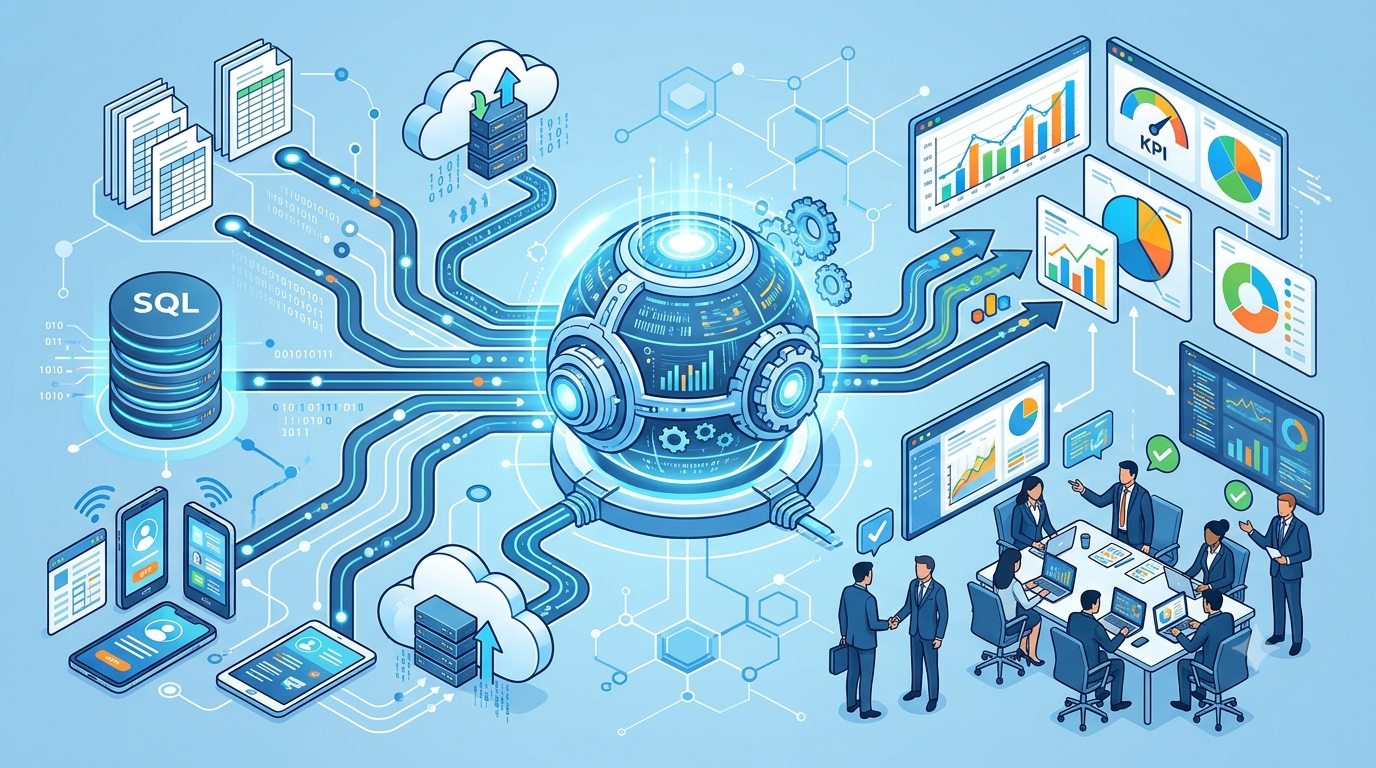
Imagine you're the captain of a cricket team.
Your team has lost five matches in a row.
Everyone has an opinion.
But opinions don't win championships.
Data does.
Now imagine someone shows you:
Suddenly, you're no longer guessing.
You're making decisions backed by evidence.
That's exactly what Data Analytics is.
It helps people and businesses make smarter decisions by turning raw data into meaningful insights.
Before understanding Data Analytics, let's understand data.
Data is raw information.
Data consists of facts, measurements, observations, or records collected from various sources. On its own, data has little meaning until it is processed and analyzed.
| Customer | Product | Price |
|---|---|---|
| Ali | Milk | ₹60 |
| Sara | Bread | ₹45 |
| John | Eggs | ₹90 |
This table is data.
Analytics is the process of discovering useful patterns, trends, and insights from information.
Imagine reading thousands of shopping receipts.
Instead of checking each receipt manually, analytics answers questions like:
Analytics transforms information into knowledge.
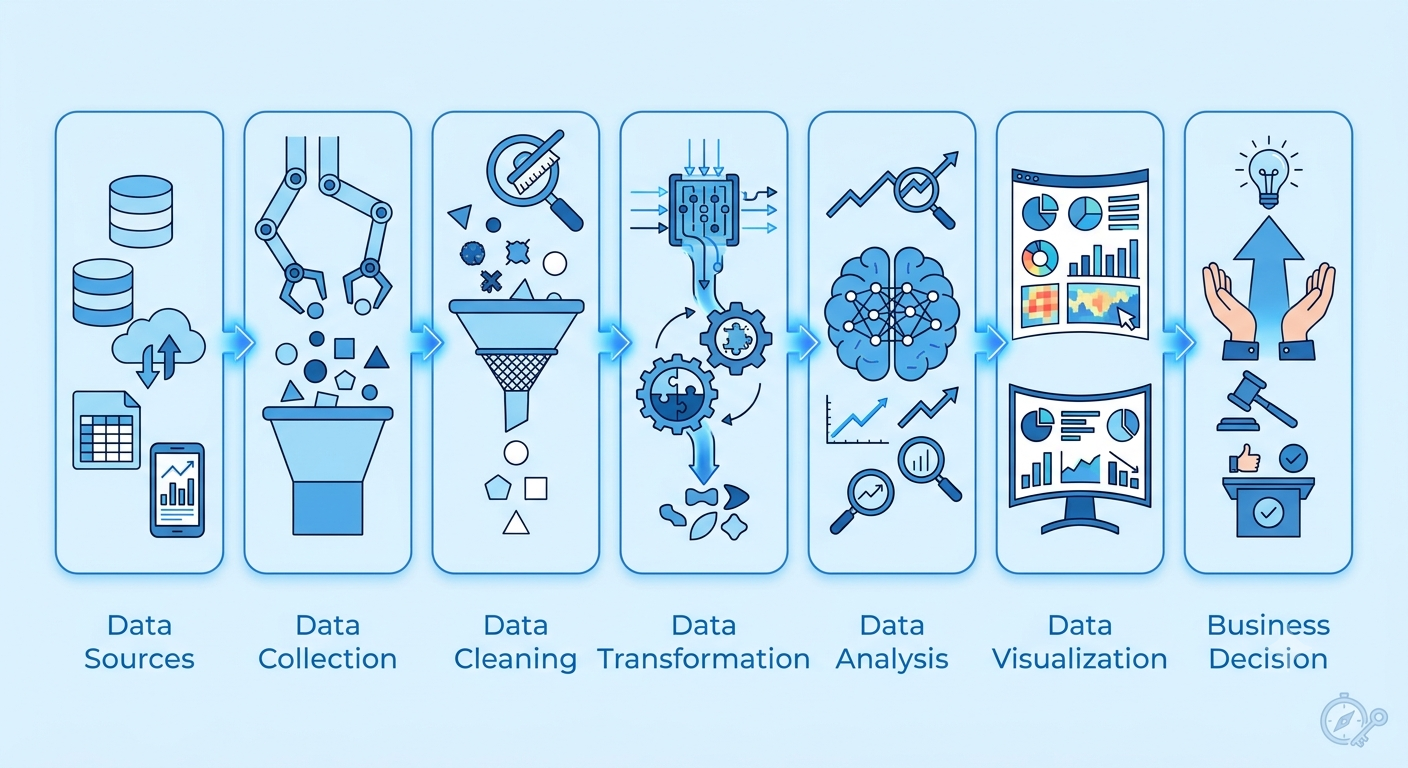
Data Analytics is the process of collecting, cleaning, transforming, analyzing, and visualizing data to make better decisions.
Think of it like cooking.
| Cooking | Data Analytics |
|---|---|
| Ingredients | Raw Data |
| Washing Vegetables | Data Cleaning |
| Recipe | Analysis Method |
| Cooking | Data Processing |
| Taste Testing | Validation |
| Serving Food | Dashboard or Report |
| Happy Customer | Better Business Decision |
Raw vegetables are not dinner.
Raw data is not insight.
Every day we generate data by:
Collecting data is easy.
Understanding it is where Data Analytics creates value.
Did You Know?
Companies like Amazon, Netflix, Uber, Google, and Spotify rely heavily on Data Analytics to improve customer experiences and business decisions.
Netflix analyzes your watch history, ratings, and viewing habits to recommend movies and TV shows you'll probably enjoy.
Amazon studies customer purchases, searches, and browsing behavior to recommend products and manage inventory.
Uber combines traffic conditions, weather, rider demand, and driver availability to calculate fares and estimate arrival times.
Hospitals analyze patient records to predict health risks, improve treatment plans, and reduce waiting times.
Every analytics project typically follows these five steps:
Each step improves the quality of insights and supports better decision-making.
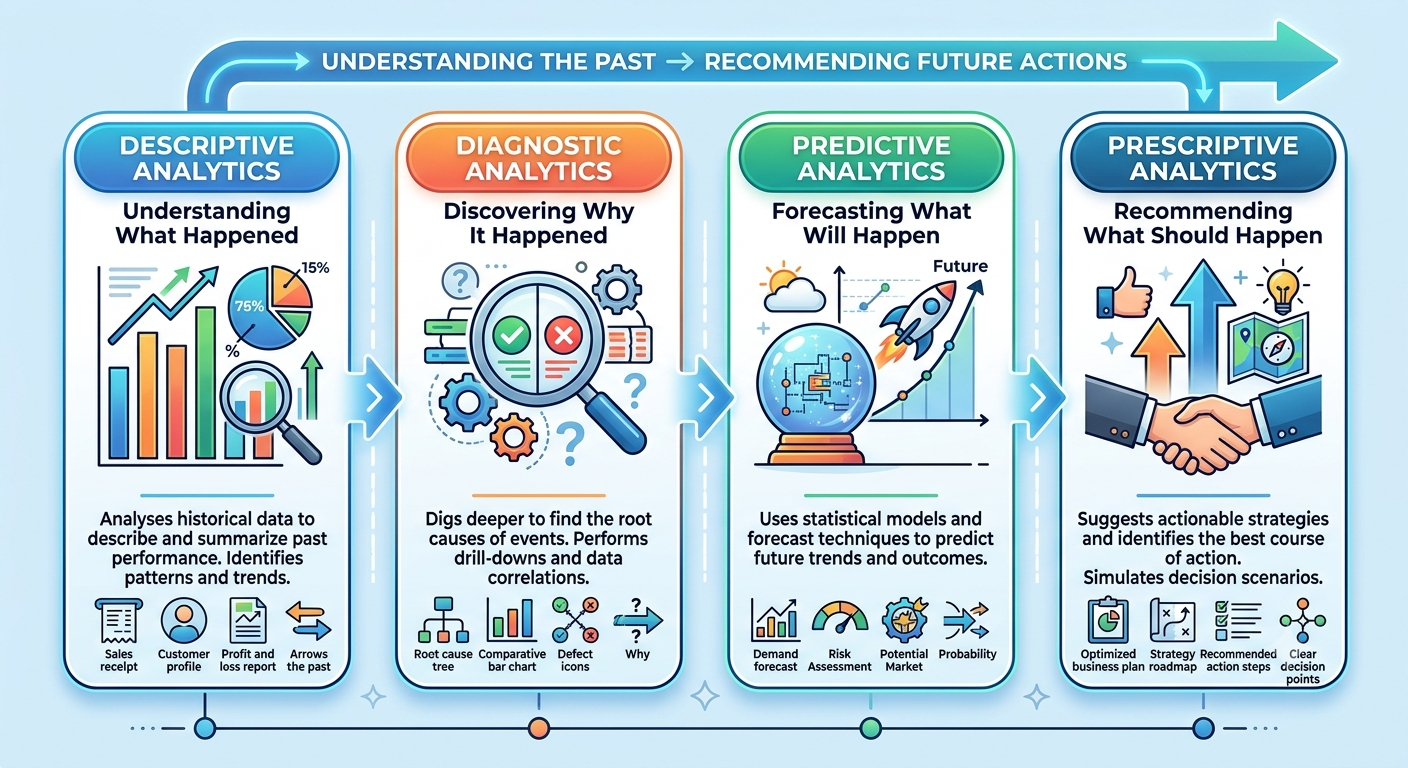
| Type | Question It Answers |
|---|---|
| Descriptive | What happened? |
| Diagnostic | Why did it happen? |
| Predictive | What is likely to happen? |
| Prescriptive | What should we do? |
Summarizes historical data.
Example: Monthly sales report.
Finds the reason behind a problem.
Example: Why did sales decrease last month?
Uses historical data to forecast future outcomes.
Example: Predicting customer churn.
Recommends the best action to take.
Example: Suggesting the best discount strategy to maximize profit.
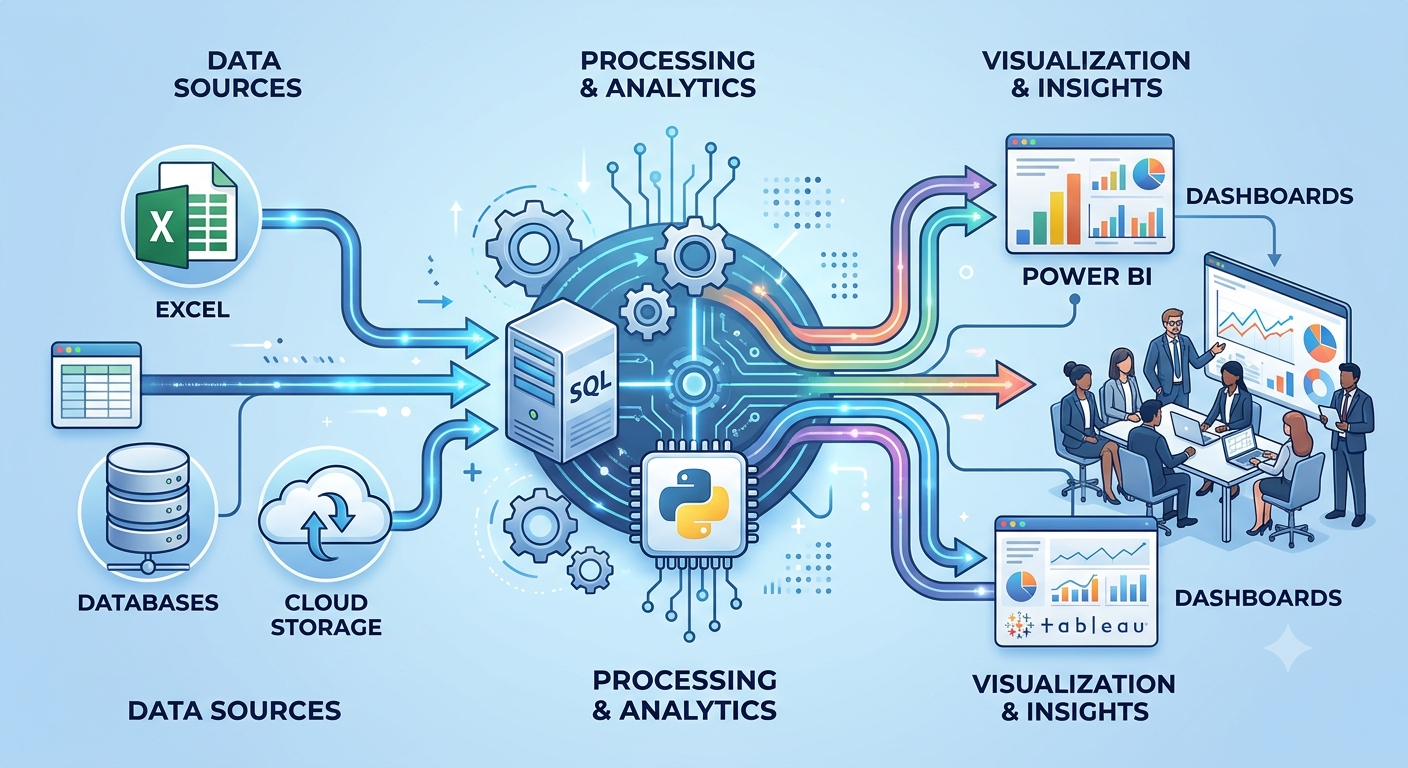
| Tool | Primary Use |
|---|---|
| Excel | Data Cleaning & Analysis |
| SQL | Querying Databases |
| Python | Automation & Advanced Analytics |
| R | Statistical Analysis |
| Power BI | Dashboards |
| Tableau | Data Visualization |
| Looker Studio | Reporting |
| Snowflake | Cloud Data Warehouse |
| Data Analytics | Data Science |
|---|---|
| Focuses on insights | Focuses on prediction and machine learning |
| Heavy use of SQL | Heavy use of programming |
| Business-oriented | Algorithm-oriented |
| Easier entry point | More mathematical |
No. Anyone can learn it step by step with consistent practice.
No. Many beginners start with Excel before learning SQL and Python.
Yes. It is one of the fastest-growing careers across healthcare, finance, retail, marketing, manufacturing, and technology.
Every business today generates enormous amounts of data.
The companies that succeed aren't the ones with the most data—they're the ones that know how to use it.
Learning Data Analytics isn't just about using tools like Excel, SQL, or Power BI. It's about asking the right questions, solving real business problems, and making confident decisions based on evidence instead of assumptions.
In the next article, we'll explore The Complete Data Analytics Process and see how raw data becomes actionable business insights.
